
POSTED
May 27, 2026
Rawalpindi and Peshawar are two of northern Pakistan's largest cities, 170 kilometres apart, framed by the foothills of the Hindu Kush and the Himalayas. In the rural and peri-urban communities between and beyond them, managing a period is still shaped by barriers far beyond biology. For many menstruators in these communities, periods have long been managed in silence and shame, often without the products, information, or support needed to experience menstruation with dignity. Fewer than a third of communities had nearby access to menstrual products, with only 34% of peri-urban shops regularly stocking them. Many women were forced to travel up to 8 kilometres for products, while 59% of adolescent girls felt uncomfortable buying pads from male shopkeepers even when they were available.
Even then, access did not always mean comfort.
More than half of women relied on cloth or improvised absorbents because products were either too expensive or inaccessible, exposing them to infections, limited mobility and stigma.
The challenge was not only about products
It was about stigma, mobility, affordability, and dignity.
To help address these barriers, the Sang pour Sang Uni.e.s Pour la Dignité consortium, through PSI Europe’s partnership with Cyntax Health Pakistan, supported the expansion of two community-led menstrual health models: the Fempure Mini Mart and the Fempure Saheli Programme. The Sang pour Sang initiative, combining catalytic funding, technical support, ecosystem linkages and capacity strengthening, supports Cyntax in refining and scaling its innovative menstrual product distribution model in underserved communities.
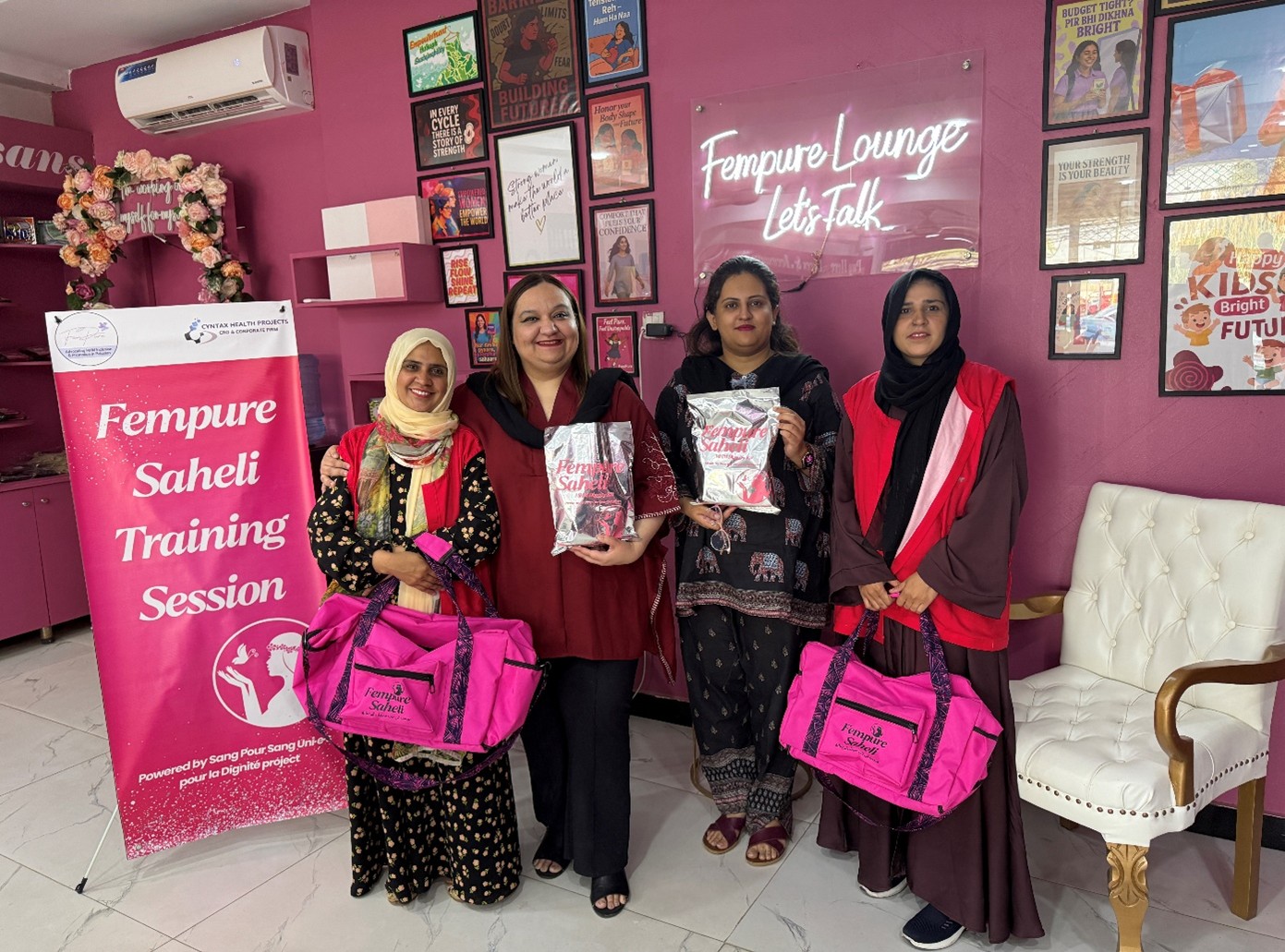
The solution is intentionally local
The Fempure Mini Marts are women-led retail and awareness hubs within communities themselves. Women can access menstrual products within walking distance while also entering a space where menstruation is discussed more openly and safely. At the same time, the Saheli Programme trains local women, including community health workers and midwives, to provide door-to-door menstrual health education and distribute products directly to households. “Fempure Saheli is creating real change in communities by combining awareness, dignity and access. The kit distribution made girls feel valued and included,” says Rabecca, a local female community leader in Peshawar. This approach helps overcome mobility barriers, information gaps and social stigma, particularly for women who rarely visited markets or felt uncomfortable purchasing products publicly.
“The Fempure Mini Mart felt like a safe and welcoming space where I could ask questions about periods without embarrassment. I bought period panties and they were extremely comfortable for daily use.”
- Sana, university Student, Peshawar
Between November 2025 and February 2026, the pilot Fempure Mini Marts sold more than 1,135 menstrual health and wellness products while operating profitably. During the same period, Sahelis in Rawalpindi and Peshawar recorded a 135% increase in product orders within the four months, reflecting growing trust in community-led menstrual health solutions. The products sold reflected not only growing demand, but also increasing awareness and choice around menstrual health, ranging from organic, disposable pads and reusable menstrual pads to organic period underwear, and menstrual health kits containing soap and bags.
But the real impact cannot be measured in sales alone
“The Saheli Program is empowering women at the community level. The kit not only provided products but saheli also provided dignity, awareness and emotional support.”
- Rabia, Housewife Community Beneficiary, Rawalpindi
The programme also created economic opportunities for women within the community. Ten women now manage Fempure Mini Marts, turning menstrual health access into a women-led enterprise model that supports both dignity and local livelihoods. Women are now leading businesses within their own communities. Girls are accessing products with more dignity and privacy. Menstrual health slowly began shifting from a hidden issue to a shared community conversation. And local women are being recognised not simply as beneficiaries, but as educators, entrepreneurs, and agents of change.
Importantly, Sang pour Sang’s support also strengthened Cyntax Health’s long-term implementation and scaling capacity. Through funding and technical support, the programme helped Cyntax test operational models, identify implementation challenges, strengthen strategic planning, and refine approaches for future expansion.
The visibility created through the initiative also helped position menstrual dignity as a broader development and equity issue within Pakistan by opening conversations with government stakeholders and development partners. The project events brought together government representatives, development partners, youth stakeholders, and community leaders to showcase menstrual health not as a hygiene issue but as a matter of dignity, gender equality, public health, and women’s economic empowerment. Discussions are now underway with the Provincial Government’s Youth Directorate to explore expanding the model through youth entrepreneurship and community development programmes, with a proposed pathway to scale up to 100 additional Fempure Mini Marts over the next five years.
However, challenges still remain. Many communities across Pakistan continue to face affordability barriers, stigma, and limited menstrual health infrastructure. Disposable products remain the most commonly used option, and menstrual health education is still unevenly accessible in many rural areas.
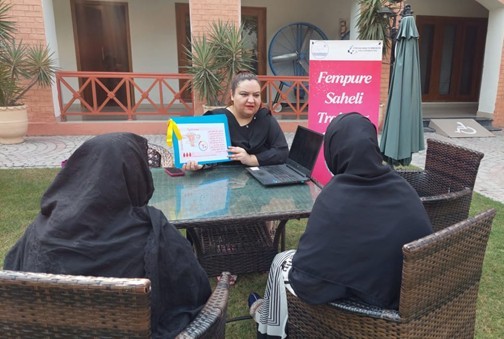
A period-friendly world rooted in dignity
The story of Cyntax Health and the women behind the Fempure models reminds us that menstrual dignity is not only about providing products. It is about creating trust, safe spaces, knowledge, economic opportunity, and the ability for women and girls to manage their periods without shame. This is what a period-friendly world looks like when menstrual dignity is led by communities themselves. When menstrual health support exists within communities, dignity becomes accessible. From women-led Mini Marts to door-to-door Saheli outreach, local women in Pakistan are transforming menstrual health into a movement of education, entrepreneurship, and empowerment.


You will be redirected in 5 seconds.


